A high-voltage tower is not a monolithic block, it is a lattice structure in which hundreds of steel sections work together to transfer the load from conductors, wind, ice and self-weight to the foundation. When one or more of those sections are corroded, deformed or damaged, the force distribution changes throughout the entire tower. The question then is not only which steel needs to be replaced, but also: can it be safely replaced without endangering the stability of the tower?
At ETD bv, we answer that question with calculations, not gut feeling.
The problem
Steel lattice towers are designed for a specific combination of loads and conditions. After decades in service, reality changes: corrosion reduces the effective cross-section of sections, wind load patterns change due to changes in the environment, and new conductors or additional equipment introduce extra loads not anticipated in the original design.
But not all damage is the result of ageing. Collisions by agricultural machinery or trucks, falling trees in storms, lightning strikes, vandalism or works in the immediate vicinity; these are all scenarios we encounter in practice. Damage ranges from a visibly bent diagonal to more subtle deformations that only come to light during inspection.
When a grid operator decides to replace damaged or weakened steelwork, a critical intermediate phase arises. Removing a member, even temporarily, changes the force distribution in the entire structure. Members that were previously lightly loaded suddenly take on considerably higher forces. Without thorough analysis of this intermediate phase, an apparently simple replacement can lead to failure of a neighbouring section, local buckling or in the worst case instability of the entire tower.
Our approach
Determination of load conditions
Every calculation starts with an accurate determination of the loads to which the tower is exposed. We model wind loads according to the local wind zone, terrain type and height class — including dynamic effects. Ice loads and combined wind-on-ice scenarios. Self-weight of tower, conductors, lightning wires and insulator strings. And conductor loads under normal operating conditions, at maximum sag and under failure load.
Global and local structural analysis
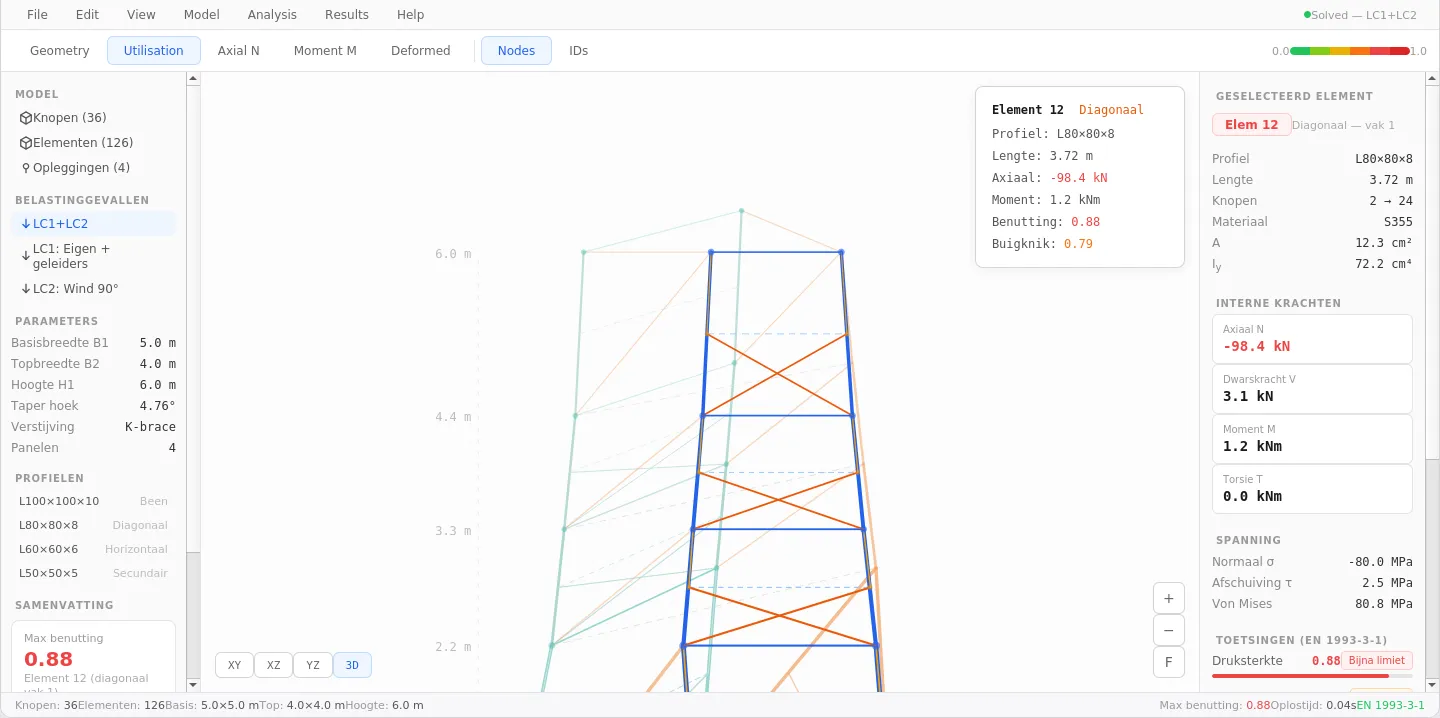
Using our proprietary software, we model the complete lattice structure as a three-dimensional bar model. Each member is individually included with its actual geometry, section dimensions and material properties. The software calculates internal forces and deformations, and performs targeted checks on strength and failure behaviour — comparing the occurring stress with the allowable values based on the actual (possibly corrosion-reduced) cross-section.
Buckling stability
Compression members in a lattice structure are particularly susceptible to buckling failure, a sudden instability in which the member deflects laterally without reaching material strength. Our software determines the buckling load of each compression member based on its buckling length, section geometry and imposed boundary conditions. This is essential when assessing temporary situations in which members have been removed and the buckling length of neighbouring sections effectively increases.
Intermediate phase analysis
We calculate not only the tower in its final state, but also in every relevant intermediate phase of the replacement process: the condition before work begins, after removal of specific members, and after installation of temporary reinforcements. Based on this analysis, we advise which members can be safely removed in which order, and where temporary auxiliary steelwork must be placed.
Dimensioning of temporary reinforcements
When the intermediate phase analysis shows that the tower retains insufficient load-bearing capacity or stability without additional measures, we dimension the required temporary reinforcements. This includes the selection of section type, determination of the required cross-section, positioning within the lattice structure and specification of the connections.
Commercial and Proprietary software
The complexity of a lattice analysis, with sometimes more than a thousand members, dozens of load cases and multiple intermediate phases, requires specialised calculation software. Generic finite element packages offer computing power, but often lack the specific checks and code verifications required in the high-voltage industry.
Besides commercial software, ETD bv has therefore developed its own software specifically tailored to the analysis of lattice structures in the high-voltage sector. Our software integrates the complete calculation chain in one environment: from reading the tower geometry and building the load model, through structural analysis, to automated verification of strength, buckling stability and deformation.
Concretely, our software provides per member and per load case a clear report with the occurring forces, the corresponding utilisation ratio and a clear indication of whether the section complies — both for strength and for buckling.
What you receive
- Overview of the applied loads and load combinations, including location-specific weather and environmental conditions
- Complete structural analysis with per-member internal forces, utilisation ratios and buckling and strength checks
- Intermediate phase analysis demonstrating the stability of the tower during every step of the replacement process
- Specification and dimensioning of temporary reinforcements with corresponding assembly instructions (if required)
- Clear advice on working conditions: maximum wind speed and phasing to be observed
Who this is for
Our structural engineering services are aimed at grid operators, contractors and engineering firms responsible for the maintenance, renovation or expansion of the high-voltage grid. Whether it concerns the replacement of a few corroded diagonals or a more complex situation. We provide the technical substantiation you need to work safely.
Is a tower intervention planned? We are happy to think along about the structural approach.
Get in touch